The Long Term Effects of Beef Sandwich Juice
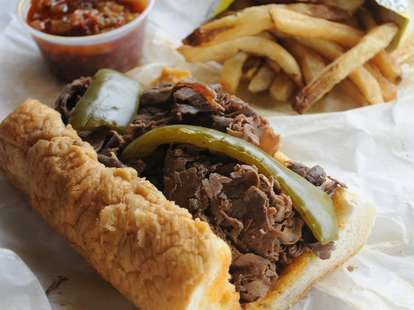
Courtesy of Al's Beef
With all due respect to the Chicago-mode hot dog and deep-dish pizza, no nutrient is more "Chicago" than the Italian beef sandwich. While it was well-nigh famously glorified past Jay Leno and playfully mocked by the Super Fans of Sat Night Alive, Chicago'due south essential culinary invention stems from inauspicious (and sometimes shady) origins on the urban center's West Side dating back about 100 years. Who invented the Italian beef? Depends who you ask.
How the Italian beefiness came to exist
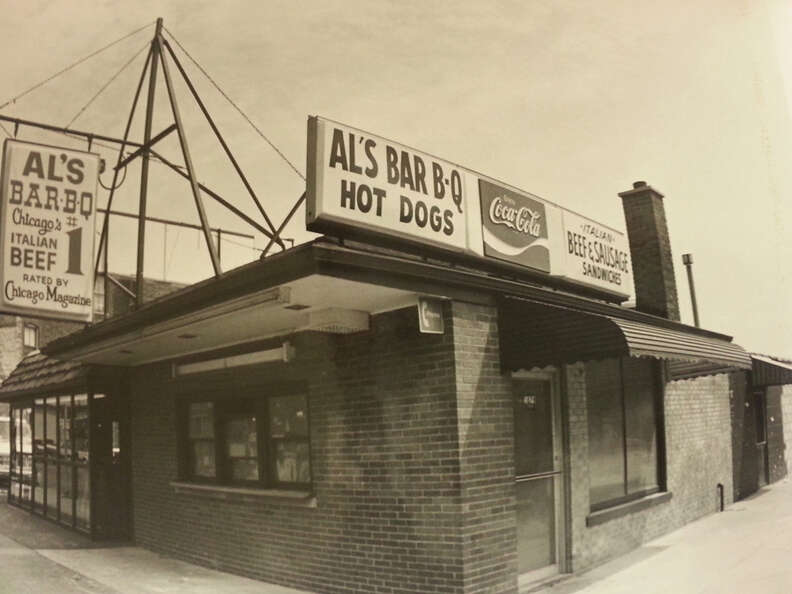
When tracing the history of the Italian beef, all roads lead through Al's #one Italian Beef on Taylor St. According to longtime Al's owner Chris Pacelli, the sandwich'southward story starts around the end of World War I with a Chicago street peddler named Anthony Ferrari. Ferrari would bulldoze around the city making deliveries of common cold sandwiches and other lunches he cooked in his dwelling to blueish-collar workers at diverse locations around the metropolis. I day he went to a local wedding and the class of Chicago culinary history was changed forever.
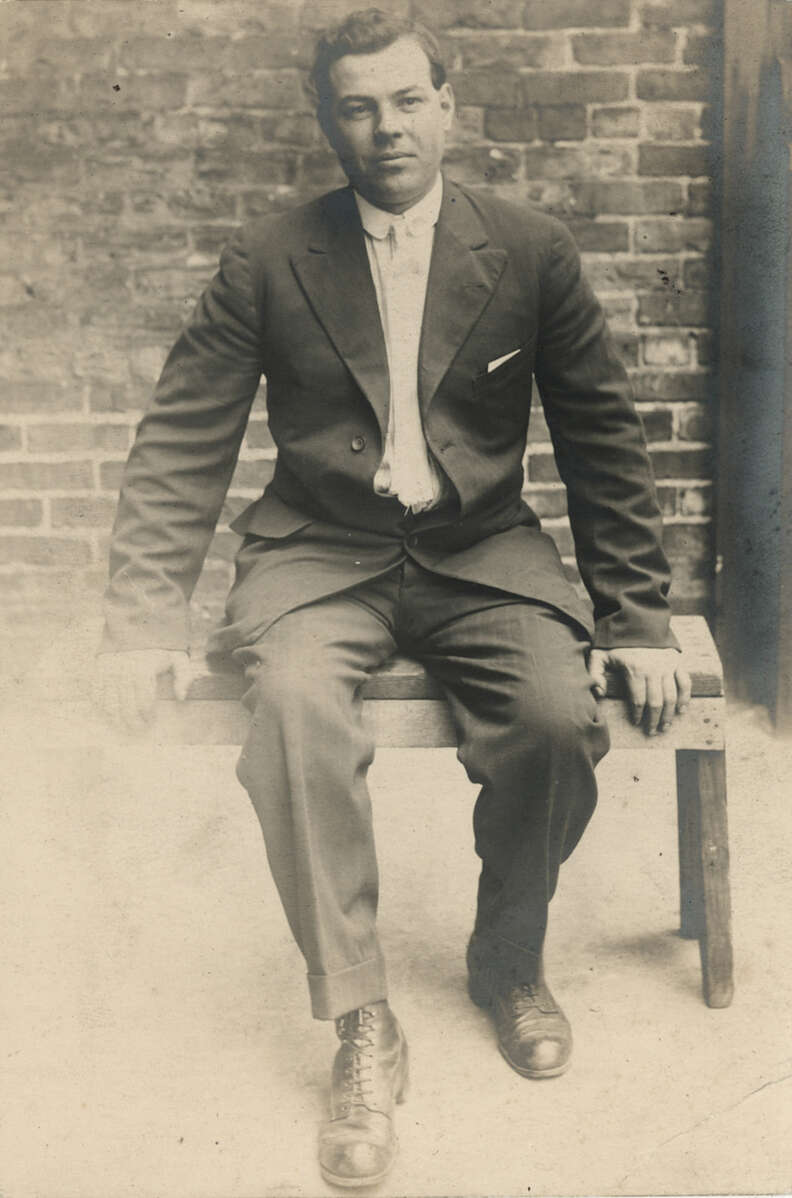
While many in the beef business claim to have invented the Italian beef, the common ground is that its origins lie in the Italian-American immigrant tradition of the "peanut wedding" prevalent amongst Italians who immigrated to Chicago in the early on 1900s. Because the new immigrants didn't have much coin, nuptials receptions would exist held in homes and church basements where peanuts and other cheap foods designed to feed equally many people as possible were served. This included cuts of beefiness.
Pacelli says beef sandwiches at peanut weddings in the early days were originally cut rather thick and Ferrari noticed that if y'all slice the beefiness thinner and cook it in its own juices, you could feed 35-40 people instead of xv-20. The thinner cut came to be known equally the Italian beef sandwich and afterwards Ferrari continued to provide the service at local weddings sporadically in addition to making to his usual lunch deliveries for the next xx years until his son, Al, decided to make a concern out of it. This is when things really get interesting.
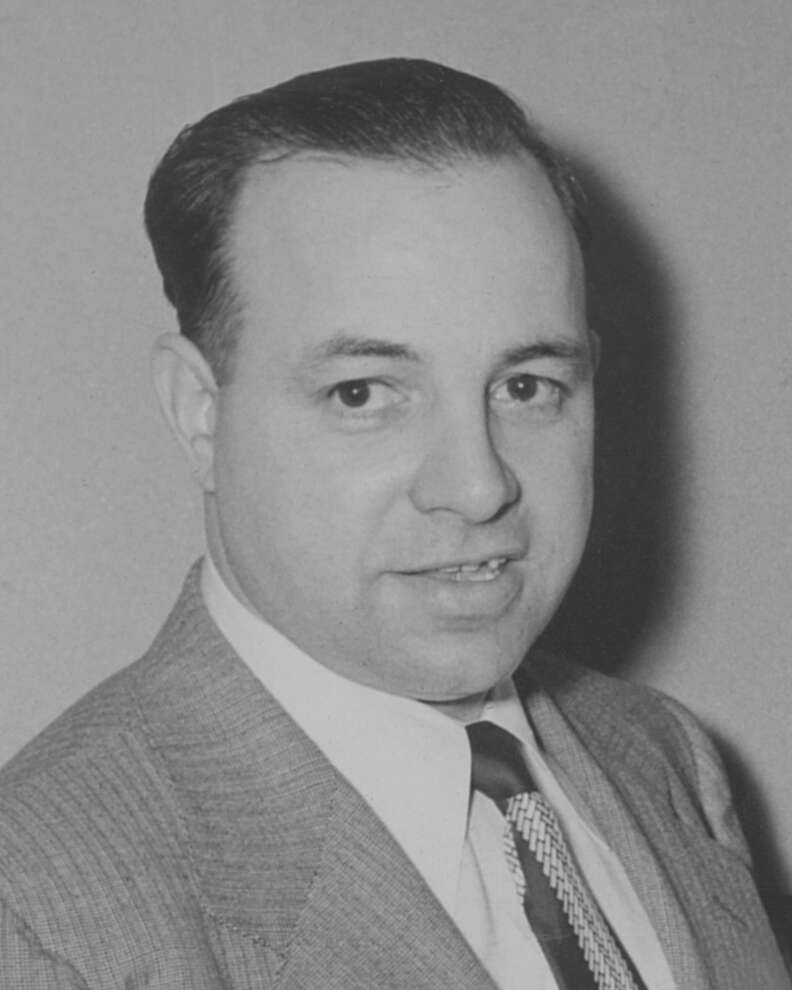
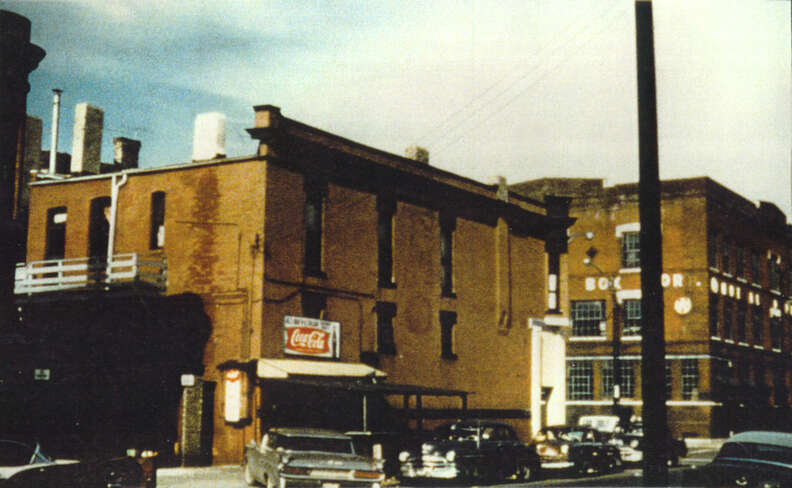
"Information technology started every bit a front for a bookie performance," says Pacelli (amend known to neighborhood locals as "Bones"), whose male parent Chris Pacelli Sr. started the business with Bones' uncle Al Ferrari in 1938. The original Al's -- originally called Al'southward Bar B-Q -- located at Harrison and Laflin St, was little more than than a pocket-size outdoor patio (or "stand," as there was no seating) where the family would take nutrient orders out front end while the gambling took place within the eatery in the back. "[Al] said, 'I'll do the beef stand up, you guys take orders in the back," says Pacelli.
Interestingly, both Pacelli's begetter and Al worked other jobs during the mean solar day, Pacelli Sr. worked for a streetcar visitor and Ferrari drove a truck, so the stand would only open at night later they were done with their solar day shifts. The original Al's operated this mode for a couple of years until Al, seeking to turn information technology into a more legitimate business organization, equally the Italian beef sandwich was growing more pop around the neighborhood, kicked out the gamblers.
As a sign of the growing popularity of the beef sandwich, Pacelli says crowds of thirty-xl people would line upward outside the beef stand but before midnight on Fridays as observant Italian-American Catholics living in the neighborhood, who couldn't consume meat on Fridays, waited for the clock to strike midnight so they could indulge in their beef-soaked gluttony.
While certainly fun, Al's account of history is disputed by some longtime heavy hitters in the local Italian beef scene. Pat Scala, whose grandfather Pasquale Scala founded Scala Packing Company in 1925, is one of the leading skeptics. The elder Scala, like Anthony Ferrari, was a peddler in Chicago's West Side selling cold cuts and sausages out of a cart around the aforementioned time every bit Ferrari. Scala's main business organisation was selling beef, and he sold some of the roasts that were used at local peanut weddings around that time and, co-ordinate to Pat Scala, his grandfather Pasquale would also piece the beef thin at weddings so more people could exist fed more than economically.
According to Scala, many different people around the neighborhood were engaged in this cooking procedure at the time, not just Al'south, and information technology's incommunicable to bear witness who actually did it first. As Italian sausage was initially the bigger concern at Al'due south in the early on years, Scala is skeptical that they've been serving Italian beefiness since 1938 as their web site claims. Scala says Al'southward was probably selling sausage back then and that the Italian beef sandwich didn't really have off in Chicago until subsequently WWII when it was fabricated available at several different beef stands in the neighborhood. (To this day, Scala Packing Co. continues to provide wholesale beef to many Italian beefiness stands effectually the urban center.)
Sandwich milestones and local legacy
The Italian beef sandwich grew in popularity in the '50s, at a time before deep dish pizza and the hamburger were widely popular and the Chicago hot domestic dog was the master Chicago working human being's food staple. Scala says that while competing beef stands began popping upwardly after WWII, the Italian beef sandwich remained primarily a neighborhood affair until the '70s, when the USDA began inspecting the meat and wholesalers like Scala began selling their beef at grocery stores, thus introducing it to a wider consumer audition.
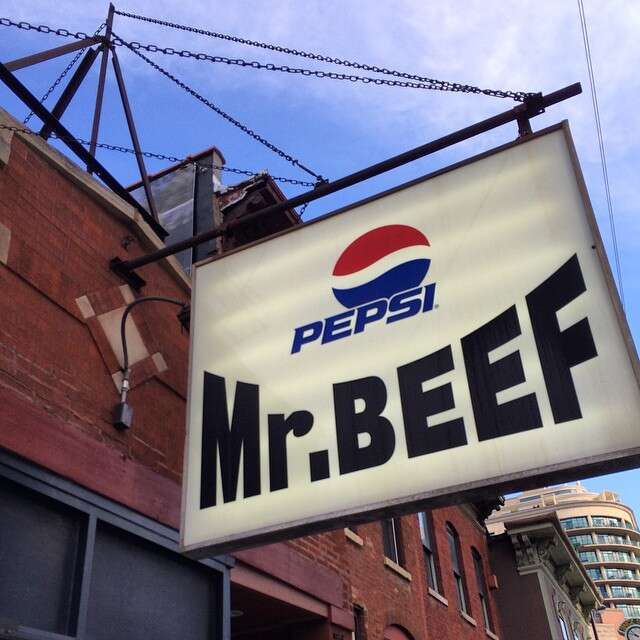
But the Italian beef sandwich didn't actually hit the national stage until the '80s, largely thanks to a then-unknown comic named Jay Leno. At that time Mr. Beef on Orleans was the only beef stand Downtown, and Leno, who was regularly doing standup effectually town equally a struggling comic at places similar Zanies, would come into Mr. Beef for his fix. Often.
"Nosotros took intendance of him," says Mr. Beef owner Joe Zucchero, who at the time doubted Leno'due south ability to make it in comedy notwithstanding still let him "mooch" off of Mr. Beefiness. "He didn't take any coin," says Zucchero. "I felt sorry for him, just as I feel sorry for homeless people." Leno, who was extremely grateful, reportedly told Zucchero, "If I ever make it big, I'1000 gonna put you everywhere."

And Jay kept his promise. One night in the '80s, Leno was booked to appear on Late Nighttime With David Letterman, and he handed out Mr. Beef sandwiches to the crowd, even going so far equally to consume i on the air. Leno would oft profess his love for Mr. Beef, and, when Jay got his own testify, the comic would go along to sing Mr. Beef's praises. This, according to Zucchero, brought the Italian beefiness sandwich more national prominence while bringing Mr. Beef a steady influx of celebrity patrons from Jim Belushi and Paul Newman to Joe Mantegna and Christopher Walken. He credits Mr. Beef's downtown location and its admission to celebrity media for pushing the Italian beefiness sandwich to the next level.

The '85 Bears and the "Super Basin Shuffle" helped shine more of a national spotlight on Chicago, and the Italian beef gained farther notoriety in the early '90s when the Saturday Night Live Super Fans helped popularize Chicago nutrient and dialect thanks to the now-iconic sketches by 2d City vets like Chris Farley, Mike Myers, and George Wendt.
More than recently, beef stands like Al'due south continue to capture the media world'due south attention with appearances on shows similar Food Wars, Man v. Food, Good Morn America, and The Today Show alongside national printing. Al's even recently brought on Ditka himself as its "official spokesperson."
While initially gaining popularity because it was cheap food for immigrants and the working grade, the sandwich has endured to this solar day as a reflection of the metropolis'southward culture. "It's a staple production in Chicago," says Carm'south Beef and Italian Ice owner Steve Devivo. He's watched generations of Chicagoans and their families get in and out of his Little Italy stand over the decades. "I think it goes hand in hand with the metropolis." It likewise helps that there is no other sandwich on Earth quite like it.
The nuances of the Italian beef
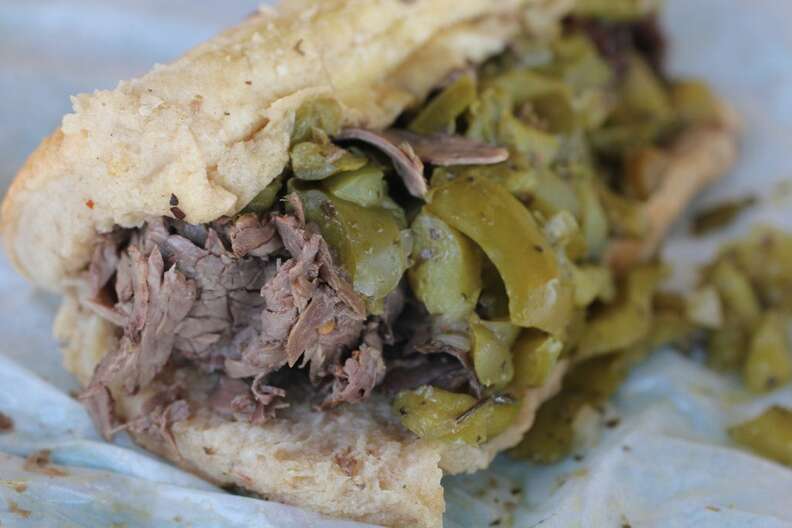
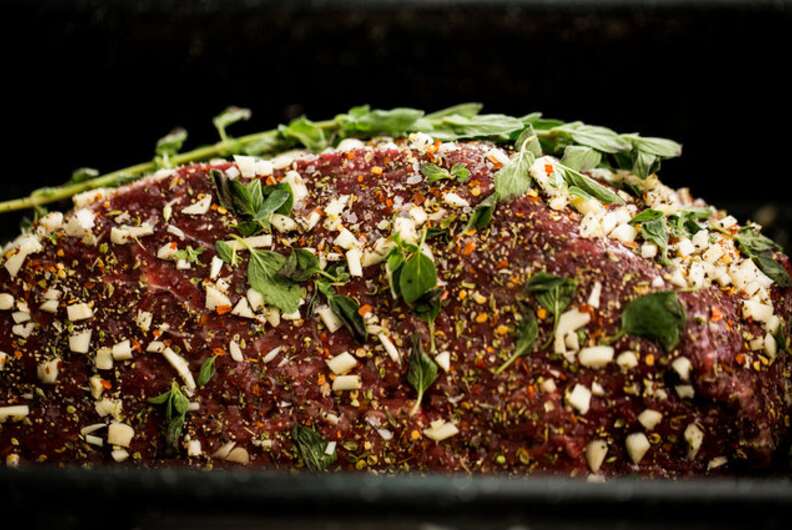
The Italian beef sandwich starts with a x-13lb roast with lots of marbling. A sirloin tip roast or acme circular roast will practice, just it needs lots of fat which is essential to its flavor development. About half of the roast is lost in the cooking process when the fat melts off and turns into the sauce (also called gravy) that is essential to a adept Italian beef. Then comes the seasoning.
"The meat is typically seasoned with dry herbs (oregano, basil) and spices (red pepper, black pepper, sometimes nutmeg, cloves, etc.) and fresh garlic or garlic powder, then roasted slowly, partially submerged in beefiness stock," Anthony Buccini writes in the upcoming book Food Metropolis: The Encyclopedia of Chicago Food, co-edited by Bruce Kraig of the Culinary Historians of Chicago. "Once cooked, the beef is cooled in guild to facilitate slicing, then the very thinly sliced meat is bathed in the reheated broth and cooking juices ('au jus,' 'juice,' 'gravy'). To class the sandwiches, forkfuls of the soaked beefiness are placed inside the bread (cut length-wise); according to private preferences."
And so come the peppers. An Italian beef sandwich with "sugariness" is topped with peppers and a beef "hot" is layered with giardiniera. Sweetness peppers are typically green (but also crimson) bell peppers cut into fatty, long chunks that y'all can lay across the length of the sandwich, tossed with olive oil, fresh garlic, salt, and pepper. The "hot" in an Italian beef comes from giardiniera, a pickled relish of spicy peppers and vegetables. Almost bigger beefiness stands make their own giardiniera, a process that many say is more complicated than actually making the beefiness.
And finally comes the bread. "The breadstuff used for beef sandwiches is of a type that former Italian bakeries in Chicago called 'French bread' and is distinguished from bones Italian bread in having a longer, narrower shape, thinner crust, and a softer, pigsty-less crumb," writes Buccini. "Small Italian bakeries and large-scale Italian bakeries of Chicagoland (Turano, Gonnella, D'Amatos) are favored sources for this breadstuff."
Devivo says the central to a adept Italian beef sandwich is the seasoning, the way you slice the beef during prep (you want it actually thin "but not shredded"), and the peppers. "Anyone tin take a slice of raw meat and melt it," he says. "The spices that you utilise differentiate your Italian beef from another place. It all comes down to the customer's preference."
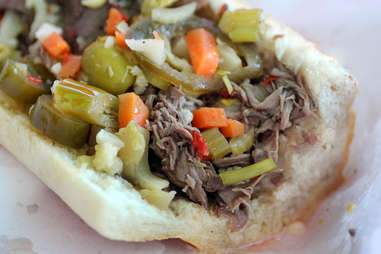
The peppers vs. giardiniera choice and overall sandwich sogginess aren't but subtle nuances of the Italian beef, they're essential elements of the ordering process. In that location are 4 common ways to club a beef sandwich, most of which have to do with how wet you desire information technology. The regular beefiness sandwich comes with juice on elevation of the meat, "dry" is served after shaking off the juice, "dipped" is where the whole sandwich is dipped quickly in the gravy, and "moisture" is where the sandwich is submerged in the juice for a longer period of fourth dimension.
"There'due south not many other sandwich traditions that revolve around soaking wet staff of life," says Maxx Parcell of the Italian beefiness Beef-Off competition held in Chicago concluding fall. "So equally I see information technology, better to embrace the tradition."
Adam Bufano, head beef guy at Al's, says other beef sandwich variations include the adding of cheese (usually provolone) to the beef to brand what is called a "cheesy beef." Al's does offer this but they do not recommend (it is pretty much considered a capital offense akin to putting ketchup on a hot dog). If you add cheese "it becomes a grinder," says Bufano. "Information technology should only exist appreciated for what it is. When you add together cheese, it becomes a whole different affair it wasn't meant to be."
It should go without saying, but some other big no-no is eating your beef with a fork and knife. "Not fifty-fifty certain why anyone would consider it," says Parcell, "merely is arguably grounds to be immediately deported from Chicago city limits." He adds that when eating an Italian beef, one should "expect to go sloppy.
Other variations of the sandwich include the "philharmonic" with a link of grilled Italian sausage added to the beef sandwich and the more rare "potato sandwich" -- a meatless bun filled with fries and drenched in juice. Pacelli adds that in the early on days when he was a kid and beef sandwiches toll 30 cents, Al's would as well sell "gravy sandwiches" (bread dipped and wrapped) to local schoolchildren at ten cents a pop.
As for eating, there'due south really merely 1 way to do information technology correctly. Y'all would be wise to heed Pacelli's advice and indulge in "The Italian Stance" when attempting to take downwards one of Chicago'southward finest culinary monstrosities. "Put your anxiety back 15in from the counter with your elbows on the counter," Pacelli says, "so all the juices end up on the floor, not on you."
In this matter, at that place is clearly no dispute.
Sign up hither for our daily Chicago email and be the start to get all the food/beverage/fun in town.
Jay Gentile is a Thrillist correspondent and he wouldn't mind crashing a peanut nuptials, every bit long as Italian beef is involved. Follow @innerviewmag
Source: https://www.thrillist.com/eat/chicago/history-of-chicagos-iconic-italian-beef-sandwich
0 Response to "The Long Term Effects of Beef Sandwich Juice"
Post a Comment