Review Danish War Axe by Arms & Armor -

Hunting and whaling take always been of import means to make a living on Greenland. One of the animals found hither is the polar bear, which is on the glaze of arms of the Danish royal family in Greenland
The history of Greenland is a history of life under farthermost Arctic conditions: currently, an ice canvass covers about eighty percent of the island, restricting human action largely to the coasts.
The outset humans are idea to have arrived in Greenland around 2500 BC. Their descendants apparently died out and were succeeded by several other groups migrating from continental North America. At that place has been no evidence discovered that Greenland was known to Europeans until the 10th century, when Icelandic Vikings settled on its southwestern coast, which seems to have been uninhabited when they arrived. The ancestors of the Inuit Greenlanders who live in that location today appear to take migrated there later, effectually Advertizing 1200, from northwestern Greenland. While the Inuit survived in the icy world of the Lilliputian Ice Age, the early Norse settlements along the southwestern coast disappeared, leaving the Inuit as the simply inhabitants of the isle for several centuries. During this time, Denmark-Norway, evidently believing the Norse settlements had survived, continued to claim sovereignty over the island despite the lack of any contact betwixt the Norse Greenlanders and their Scandinavian brethren. In 1721, aspiring to get a colonial power, Denmark-Norway sent a missionary expedition to Greenland with the stated aim of reinstating Christianity among descendants of the Norse Greenlanders who may have reverted to paganism. When the missionaries establish no descendants of the Norse Greenlanders, they baptized the Inuit Greenlanders they establish living there instead. Denmark-Kingdom of norway then developed trading colonies along the declension and imposed a merchandise monopoly and other colonial privileges on the area.
During Earth State of war Ii, when Deutschland invaded Kingdom of denmark, Greenlanders became socially and economically less connected to Denmark and more connected to the United States.[1] Afterward the war, Denmark resumed control of Greenland and in 1953, converted its status from colony to overseas amt (canton). Although Greenland is still a function of the Kingdom of Denmark, it has enjoyed domicile rule since 1979. In 1985, the isle decided to get out the European Economic Community (EEC), which it had joined equally a part of Denmark in 1973; the Faroes had never joined.
Early Paleo-Inuit cultures [edit]

Chill cultures from 900 to 1500:
The prehistory of Greenland is a story of repeated waves of Paleo-Inuit immigration from the islands due north of the North American mainland. (The peoples of those islands are thought to accept descended, in turn, from inhabitants of Siberia who migrated into Canada thousands of years ago.) Because of Greenland's remoteness and climate, survival there was difficult. Over the course of centuries, ane civilisation succeeded some other as groups died out and were replaced by new immigrants. Archæology can give only judge dates for the cultures that flourished before the Norse exploration of Greenland in the 10th century.
The earliest known cultures in Greenland are the Saqqaq culture (2500–800 BC)[2] and the Independence I culture in northern Greenland (2400–1300 BC). The practitioners of these two cultures are thought to take descended from dissever groups that came to Greenland from northern Canada.[3] Around 800 BC, the so-chosen Independence II civilization arose in the region where the Independence I culture had previously existed.[4] It was originally thought that Independence Ii was succeeded by the early Dorset culture (700 BC–Advertising one), but some Independence Ii artifacts appointment from as recently as the 1st century BC. Contempo studies suggest that, in Greenland at least, the Dorset civilization may be better understood as a continuation of Independence 2 culture; the ii cultures take therefore been designated "Greenlandic Dorset".[5] Artefacts associated with early Dorset civilization in Greenland accept been found as far north every bit Inglefield Land on the west coast and the Pigeon Bay area on the e coast.[6]
Subsequently the Early Dorset civilization disappeared by around AD 1, Greenland was apparently uninhabited until Late Dorset people settled on the Greenlandic side of the Nares strait effectually 700.[5] The late Dorset civilisation in the north of Greenland lasted until about 1300.[vii] Meanwhile, the Norse arrived and settled in the southern part of the isle in 980.
Norse settlement [edit]
Europeans probably became aware of Greenland'due south being in the early on 10th century, after Gunnbjörn Ulfsson, while sailing from Norway to Iceland, was diddled off course by a storm and sighted some islands off Greenland. During the 980s explorers led by Erik the Scarlet set out from Iceland and reached the southwest coast of Greenland. They found the region uninhabited, and subsequently settled there. Erik named the island "Greenland" (Grœnland in Old Norse, Grænland in modern Icelandic, Grønland in mod Danish and Norwegian). Both the Book of Icelanders (Íslendingabók, a medieval account of Icelandic history from the 12th century onward) and the Saga of Eric the Red (Eiríks saga rauða, a medieval account of his life and of the Norse settlement of Greenland) state that Erik said that it would encourage people to go there that the land had a good proper name."[8] [ failed verification – see discussion] [9]
According to the sagas, the Icelanders had exiled Erik the Scarlet for 3 years for committing murder,[10] c. 982. He sailed to Greenland, where he explored the coastline and claimed certain regions as his own. He then returned to Iceland to persuade people to join him in establishing a settlement on Greenland. The Icelandic sagas say that 25 ships left Iceland with Erik the Red in 985, and that only 14 of them arrived safely in Greenland.[xi] Radiocarbon dating of remains at the first settlement at Brattahlid (at present Qassiarsuk) have approximately confirmed this timeline, yielding a appointment of about thou. According to the sagas, in the yr grand Erik's son, Leif Eirikson, left the settlement to explore the regions effectually Vinland, which historians generally assume to accept been located in present-day Newfoundland.
The Norse established settlements along Greenland'south due south-western fjords. Information technology is possible that the bottom lands of the southern fjords at that fourth dimension were covered past highgrown shrub and surrounded by hills covered with grass and castor (as the Qinngua Valley currently is), merely this hasn't been adamant yet.[12] If the presumption is true then the Norse probably cleared the landscape by felling trees to utilize as building material and equally fuel, and by assuasive their sheep and goats to graze there in both summer and winter. Whatever resultant soil erosion could take become an important factor in the demise of the colonies, as the country was stripped of its natural cover.
The Norse settled in 3 separate locations in south-western Greenland: the larger Eastern Settlement, the smaller Western Settlement, and the nonetheless smaller Middle Settlement (often considered function of the Eastern one). Estimates put the combined population of the settlements at their elevation between 2,000 and 10,000, with recent estimates[xiii] trending toward the lower figure. Archeologists accept identified the ruins of approximately 620 farms: 500 in the Eastern Settlement, 95 in the Western Settlement, and 20 in the Heart Settlement.

Summer on the Greenland coast c. 1000
The economy of the Norse Greenlanders depended on a combination of pastoral farming with hunting and some fishing. Farmers kept cattle, sheep and goats - shipped into the island - for their milk, cheese and butter, while almost of the consumed meat came from hunted caribou and seals. Both individual farmers and groups of farmers organised summertime trips to the more northerly Disko Bay area, where they hunted walruses, narwhals and polar bears for their skins, hides and ivory. Also their apply in making garments and shoes, these resources also functioned as a form of currency, also as providing the most of import export commodities.[14]
The Greenland settlements carried on a merchandise with Europe in ivory from walrus tusks, every bit well equally exporting rope, sheep, seals, wool and cattle hides (according to one 13th-century account).[ citation needed ] They depended on Iceland and Norway for iron tools, wood (peculiarly for boat edifice, although they may besides have obtained wood from coastal Labrador - Markland), supplemental foodstuffs, and religious and social contacts. For a time, trade ships from Iceland and Norway traveled to Greenland every yr and would sometimes overwinter in Greenland. Beginning in the late-13th century, laws required all ships from Greenland to sail direct to Norway. The climate became increasingly colder in the 14th and 15th centuries, during the period of colder weather known as the Piffling Ice Age.
In 1126 the Roman Catholic Church founded a diocese at Garðar (at present Igaliku). It was subject to the Norwegian archdiocese of Nidaros (now Trondheim); at least 5 churches in Norse Greenland are known from archeological remains. In 1261 the population accepted the overlordship of the King of Kingdom of norway, although information technology continued to accept its ain law. In 1380 the Norwegian kingdom entered into a personal union with the Denmark.
Later on initially thriving, the Norse settlements in Greenland declined in the 14th century. The Norse abandoned the Western Settlement around 1350. In 1378 in that location was no longer a bishop at Garðar. In 1379 Inuit attacked the Eastern Settlement, killed xviii men and captured ii boys and a woman.[15] In 1402–1404 the Black Death hit Iceland for the starting time time and killed approximately half the population there - but there is no show that it reached Greenland.[sixteen] The last written record of the Norse Greenlanders documents a matrimony in 1408 at Hvalsey Church, whose ruins are the best-preserved of the Norse buildings of that period.
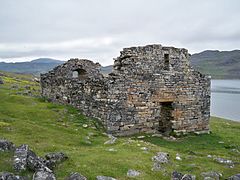
Afterward 1408 few written records mention the settlers. Correspondence between the Pope and the Biskop Bertold af Garde dates from the same yr.[17] The Danish cartographer Claudius Clavus seems to have visited Greenland in 1420, according to documents written by Nicolas Germanus and Henricus Martellus, who had access to original cartographic notes and a map past Clavus. In the late 20th century the Danish scholars Bjönbo and Petersen constitute two mathematical manuscripts containing the second chart of the Claudius Clavus map from his journey to Greenland (where he himself mapped the surface area).[18]
In a letter dated 1448 from Rome, Pope Nicholas 5 instructed the bishops of Skálholt and Hólar (the ii Icelandic episcopal sees) to provide the inhabitants of Greenland with priests and a bishop, the latter of which they had not had in the xxx years since a purported set on by "heathens" who destroyed most of the churches and took the population prisoner.[19] It is probable that the Eastern Settlement was defunct by the centre of the 15th century, although no verbal appointment has been established. A European ship that landed in the former Eastern Settlement in the 1540s establish the corpse of a Norse man there,[xx] which may be the final mention of a Norse individual from the settlement.[21]
Norse failure [edit]

A graphical description of changes in temperature in Greenland from 500 – 1990 based on assay of the deep ice core from Greenland and some historical events. The almanac temperature changes are shown vertical in ˚C. The numbers are to be read horizontal:
1. From 700 to 750 people belonging to the Tardily Dorset Civilization move into the area around Smith Sound, Ellesmere Isle and Greenland north of Thule.
2. Norse settlement of Iceland starts in the second half of the ninth century.
3. Norse settlement of Greenland starts just earlier the year 1000.
iv. Thule Inuit move into northern Greenland in the 12th century.
5. Late Dorset civilisation disappears from Greenland in the second half of the 13th century.
half-dozen. The Western Settlement disappears in mid 14th century.
7. In 1408 is the Marriage in Hvalsey, the last known written certificate on the Norse in Greenland.
8. The Eastern Settlement disappears in mid 15th century.
nine. John Cabot is the commencement European in the mail-Republic of iceland era to visit Labrador - Newfoundland in 1497.
10. "Little Ice Age" from c. 1600 to mid 18th century.
11. The Norwegian priest Hans Egede arrives in Greenland in 1721.
In that location are many theories as to why the Norse settlements in Greenland collapsed after surviving for some 450–500 years (985 to 1450–1500). Among the factors that accept been suggested every bit contributing to the demise of the Greenland colony are:[22] [23]
- Cumulative environmental harm
- Gradual climate change
- Conflicts with Inuit peoples
- Loss of contact and support from Europe
- Cultural conservatism and failure to suit to an increasingly harsh natural surround
- Opening of opportunities elsewhere after plague had left many farmsteads abandoned in Iceland and Kingdom of norway
- Declining value of ivory in Europe (due to the influx of ivory from Russian walrus and African elephants), forcing hunters to overkill the walrus populations and endanger their ain survival[24]
Numerous studies have tested these hypotheses and some take led to pregnant discoveries. In The Frozen Repeat, Kirsten Seaver contests some of the more generally accepted theories about the demise of the Greenland colony, and asserts that the colony, towards the end, was healthier than some scholars previously claimed. Seaver believes that the Greenlanders cannot take starved to death, merely rather may accept been wiped out by Inuit or unrecorded European attacks, or they may accept abandoned the colony for Iceland or Vinland. Withal, the physical evidence from archeological studies of the ancient farm sites does not evidence evidence of attack.[ citation needed ] The paucity of personal belongings at these sites is typical of Northward Atlantic Norse sites that were abased in an orderly way, with any useful items being deliberately removed; but to others information technology suggests a gradual but devastating impoverishment. Middens at these sites exercise show an increasingly impoverished diet for humans and livestock. Else Roesdahl argues that declining ivory prices in Europe due to the influx of Russian and African ivory adversely affected the Norse settlements in Greenland, which depended largely on the export of walrus ivory to Europe.[25]
Greenland was always colder in winter than Iceland and Norway, and its terrain less hospitable to agriculture. Erosion of the soil was a danger from the beginning, ane that the Greenland settlements may not have recognized until it was too late. For an extended time, nonetheless, the relatively warm West Greenland electric current flowing northwards along the southwestern coast of Greenland made it feasible for the Norse to farm much as their relatives did in Iceland or northern Norway. Palynologists' tests on pollen counts and fossilized plants prove that the Greenlanders must have struggled with soil erosion and deforestation.[15] A Norse farm in the Vatnahverfi district, excavated in the 1950s, had been cached in layers of drifting sand upward to 10 feet deep. As the unsuitability of the country for agriculture became more and more patent, the Greenlanders resorted starting time to pastoralism and so to hunting for their nutrient.[fifteen] But they never learned to employ the hunting techniques of the Inuit, one existence a farming culture, the other living on hunting in more northern areas with pack ice.[fifteen]
To investigate the possibility of climatic cooling, scientists drilled into the Greenland ice cap to obtain core samples, which suggested that the Medieval Warm Period had caused a relatively milder climate in Greenland, lasting from roughly 800 to 1200. Still, from 1300 or so the climate began to cool. By 1420, the "Niggling Ice Historic period" had reached intense levels in Greenland.[26] Excavations of middens from the Norse farms in both Greenland and Republic of iceland show the shift from the basic of cows and pigs to those of sheep and goats. As the winters diffuse, and the springs and summers shortened, in that location must have been less and less fourth dimension for Greenlanders to abound hay. A study of North Atlantic seasonal temperature variability showed a significant decrease in maximum summertime temperatures offset in the late 13th century to early 14th century—as much as six-8 °C lower than modernistic summertime temperatures.[27] The study also constitute that the lowest winter temperatures of the last 2,000 years occurred in the belatedly 14th century and early on 15th century. Past the mid-14th century deposits from a chieftain's subcontract showed a big number of cattle and caribou remains, whereas, a poorer farm only several kilometers away had no trace of domestic fauna remains, simply seal. Bone samples from Greenland Norse cemeteries ostend that the typical Greenlander diet had increased past this time from 20% body of water animals to 80%.[28]
Although Greenland seems to accept been uninhabited at the time of initial Norse settlement, the Thule people migrated south and finally came into contact with the Norse in the twelfth century. There are limited sources showing the two cultures interacting; still, scholars know that the Norse referred to the Inuit (and Vinland natives) as skræling. The Icelandic Register are amongst the few existing sources that confirm contact between the Norse and the Inuit. They report an example of hostility initiated by the Inuit against the Norse, leaving 18 Greenlanders dead and ii boys carried into slavery.[29] Archaeological evidence seems to testify that the Inuit traded with the Norse. On the other paw, the prove shows many Norse artefacts at Inuit sites throughout Greenland and on the Canadian Arctic islands simply very few Inuit artefacts in the Norse settlements. This may indicate either European indifference—an case of cultural resistance to Inuit crafts among them—or perhaps hostile raiding past the Inuit. It is besides quite possible that the Norse were trading for perishable items such as meat and furs and had little involvement in other Inuit items, much equally afterwards Europeans who traded with Native Americans.
The Norse never learned the Inuit techniques of kayak navigation or ring seal hunting. Archaeological bear witness apparently establishes that by 1300 or so the Inuit had successfully expanded their wintertime settlements as close to the Europeans as the outer fjords of the Western Settlement. By 1350, the Norse had completely deserted their Western Settlement.[30] The Inuit, being a hunting society, may have hunted the Norse livestock, forcing the Norse into disharmonize or abandonment of their settlements.[ citation needed ]
In mild weather conditions, a ship could brand the 900-mile (1400 kilometers) trip from Iceland to Eastern Settlement within a couple of weeks. Greenlanders had to keep in contact with Iceland and Norway in order to trade. Little is known most any distinctive shipbuilding techniques among the Greenlanders. Greenland lacks a supply of lumber, so was completely dependent on Icelandic merchants or, peradventure, logging expeditions to the Canadian declension.[ citation needed ]
The sagas mention Icelanders traveling to Greenland to trade.[31] Settlement chieftains and large subcontract owners controlled this trade. Chieftains would trade with the foreign ships and and then disperse the appurtenances by trading with the surrounding farmers.[32] The Greenlanders' chief article was the walrus tusk,[22] which was used primarily in Europe as a substitute for elephant ivory for art décor, whose trade had been blocked past conflict with the Islamic world. Professor Gudmundsson suggests a very valuable narwhal tusk trade, through a smuggling road between western Iceland and the Orkney islands.[ citation needed ]
It has been argued that the royal Norwegian monopoly on shipping contributed to the end of trade and contact. However, Christianity and European customs continued to hold sway among the Greenlanders for the greater part of the 14th and 15th centuries. In 1921, a Danish historian, Paul Norland, found homo remains from the Eastern Settlement in the Herjolfsnes church courtyard. The bodies were dressed in 15th century medieval habiliment with no indications of malnutrition or inbreeding. Near had crucifixes effectually their necks with their arms crossed as in a stance of prayer. Roman papal records report that the Greenlanders were excused from paying their tithes in 1345 because the colony was suffering from poverty.[33] The last reported ship to achieve Greenland was a individual send that was "blown off course", reaching Greenland in 1406, and departing in 1410 with the last news of Greenland: the burning at the stake of a condemned male person witch, the insanity and death of the woman this witch was accused of attempting to seduce through witchcraft, and the marriage of the send's helm, Thorsteinn Ólafsson, to another Icelander, Sigríður Björnsdóttir.[34] However, there are some suggestions of much afterward unreported voyages from Europe to Greenland, mayhap as late equally the 1480s.[35] In the 1540s,[11] a ship drifted off-course to Greenland and discovered the body of a dead man lying face downward who demonstrated cultural traits of both Norse and Inuit. An Icelandic coiffure fellow member of the ship wrote: "He had a hood on his caput, well sewn, and wearing apparel from both homespun and sealskin. At his side lay a carving knife bent and worn downwards by whetting. This pocketknife they took with them for display."[36]
According to a 2009 written report, "there is no evidence for perceptible contact between Iceland and Greenland after the mid fifteenth century... It is clear that neither Danish and Norwegian nor Icelandic public functionaries were enlightened that the Norse Greenland colony had ceased to be. Effectually 1514, the Norwegian archbishop Erik Valkendorf (Danish by birth, and even so loyal to Christian II) planned an expedition to Greenland, which he believed to be part of a continuous northern landmass leading to the New World with all its wealth, and which he fully expected yet to accept a Norse population, whose members could be pressed anew to the bosom of church building and crown after an interval of well over a hundred years. Presumably, the archbishop had better archives at his disposal than most people, and yet he had non heard that the Greenlanders were gone."[25]
One intriguing fact is that very few fish remains are found among their middens. This has led to much speculation and statement. Well-nigh archaeologists reject any decisive judgment based on this ane fact, even so, as fish bones decompose more than quickly than other remains, and may take been disposed of in a different fashion. Isotope analysis of the bones of inhabitants shows that marine nutrient sources supplied more and more of the diet of the Norse Greenlanders, making upward betwixt fifty% and fourscore% of their nutrition by the 14th century.[37]
One Inuit story recorded in the 18th century tells that raiding expeditions by European ships over the course of three years destroyed the settlement, after which many of the Norse sailed abroad southward and the Inuit took in some of the remaining women and children before the final assail.[11]
Belatedly Dorset and Thule cultures [edit]
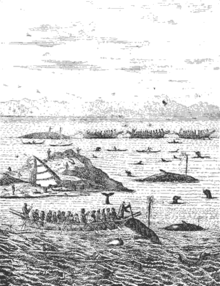
The Belatedly Dorset culture inhabited Greenland until the early fourteenth century.[38] This culture was primarily located in the northwest of Greenland, far from the Norse who lived around the southern coasts. Archaeological evidence points to this culture predating the Norse or Thule settlements.[39] In the region of this civilization, at that place is archaeological bear witness of gathering sites for around four to thirty families, living together for a brusque fourth dimension during their move cycle.
Around AD 1300–1400, the Thule arrived from the westward settling in the Northeast areas of Greenland.[40] These people, the ancestors of the mod Greenland Inuit,[39] [41] were flexible and engaged in the hunting of almost all animals on state and in the bounding main, including walrus, narwhal, and seal.[42] [43] The Thule adjusted well to the environment of Greenland, as archaeological prove indicates that the Thule were not using all parts of hunting kills, unlike other arctic groups, meaning they were able to waste more resource due to either surplus or well adjusted behaviors.[42]
The nature of the contacts between the Dorset and Norse cultures is not clear, only may take included trade elements. The level of contact is currently the subject of widespread fence, perhaps including Norse trade with Thule or Dorsets in Canada.
Danish recolonization [edit]
Near of the former Norse records concerning Greenland were removed from Trondheim to Copenhagen in 1664 and afterwards lost, probably in the Copenhagen Burn down of 1728.[44] The precise date of rediscovery is uncertain because south-drifting icebergs during the Little Ice Age long fabricated the eastern declension unreachable. This led to full general confusion between Baffin Island, Greenland, and Spitsbergen, every bit seen, for example, in the difficulty locating the Frobisher "Strait", which was non confirmed to be a bay until 1861. Nonetheless, involvement in discovering a Northwest Passage to Asia led to repeated expeditions in the area, though none were successful until Roald Amundsen in 1906 and even that success involved his being iced in for two years. Christian I of Denmark purportedly sent an trek to the region under Pothorst and Pining to Greenland in 1472 or 1473; Henry 7 of England sent another under Cabot in 1497 and 1498; Manuel I of Portugal sent a third under Corte-Real in 1500 and 1501. It had certainly been generally charted by the 1502 Cantino map, which includes the southern coastline.[44] The island was "rediscovered" yet again by Martin Frobisher in 1578, prompting King Frederick Ii of Denmark to outfit a new trek of his own the next year under the Englishman James Alday; this proved a costly failure.[44] The influence of English and Dutch whalers became and so pronounced that for a time the western shore of the island itself became known as "Davis Strait" (Dutch: Straat Davis) after John Davis's 1585 and 1586 expeditions, which charted the western coast as far north as Disko Bay.[45]
Meanwhile, following Sweden's exit from the Kalmar Marriage, the remaining states in the personal marriage were reorganized into Denmark-Norway in 1536. In protestation against foreign involvement in the region, the Greenlandic polar bear was included in the state's coat of arms in the 1660s (it was removed in 1958 but remains part of the royal coat of arms). In the second one-half of the 17th century Dutch, German language, French, Basque, and Dano-Norwegian ships hunted bowhead whales in the pack ice off the due east declension of Greenland, regularly coming to shore to trade and replenish drinking water. Foreign trade was later forbidden past Danish monopoly merchants.
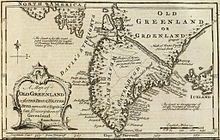
A 1747 map based on Egede'southward descriptions, including many geographical errors common to the fourth dimension.
From 1711 to 1721,[46] the Norwegian cleric Hans Egede petitioned Rex Frederick Four of Denmark for funding to travel to Greenland and re-establish contact with the Norse settlers in that location. Presumably, such settlers would still be Catholic or fifty-fifty heathen and he desired to found a mission amongst them to spread the Reformation.[47] Frederick permitted Egede and some Norwegian merchants to establish the Bergen Greenland Company to revive merchandise with the island simply refused to grant them a monopoly over it for fearfulness of antagonizing Dutch whalers in the area.[48] The Purple Mission College assumed dominance over the mission and provided the company with a modest stipend. Egede found merely misidentified the ruins of the Norse colony, went bankrupt amid repeated attacks by the Dutch, and found lasting conversion of the migrant Inuit exceedingly hard. An endeavor to constitute a regal colony nether Major Claus Paarss established the settlement of Godthåb ("Good Hope") in 1728, but became a costly debacle which saw nearly of the soldiers mutiny[47] and the settlers killed past scurvy.[49] Two child converts sent to Copenhagen for the coronation of Christian Six returned in 1733 with smallpox, devastating the isle. The same ship that returned them, nevertheless, also brought the first Moravian missionaries, who in time would convert a former angekok (Inuit shaman), experience a revival at their mission of New Herrnhut, and constitute a string of mission houses along the southwest coast. Around the aforementioned time, the merchant Jacob Severin took over administration of the colony and its trade, and having secured a large imperial stipend and full monopoly from the king, successfully repulsed the Dutch in a serial of skirmishes in 1738 and 1739. Egede himself quit the colony on the decease of his wife, leaving the Lutheran mission to his son Poul. Both of them had studied the Kalaallisut language extensively and published works on it; as well, Poul and some of the other clergy sent by the Mission College, such as Otto Fabricius, began wide-ranging written report of Greenland's flora, fauna, and meteorology. However, though kale, lettuce, and other herbs were successfully introduced, repeated attempts to cultivate wheat or clover failed throughout Greenland, limiting the ability to raise European livestock.[46]
As a issue of the Napoleonic Wars, Norway was ceded to Sweden at the 1814 Treaty of Kiel. The colonies, including Greenland, remained in Danish possession. The 19th century saw increased interest in the region on the role of polar explorers and scientists similar William Scoresby and Greenland-born Knud Rasmussen. At the aforementioned fourth dimension, the colonial elements of the earlier trade-oriented Danish presence in Greenland expanded. In 1861, the first Greenlandic-linguistic communication journal was founded. Danish law still applied to only the Danish settlers, though. At the turn of the 19th century, the northern part of Greenland was still sparsely populated; only scattered hunting inhabitants were constitute at that place.[50] During that century, notwithstanding, Inuit families immigrated from British North America to settle in these areas. The last group from what later became Canada arrived in 1864. During the same time, the northeastern part of the coast became depopulated following the fierce 1783 Lakagígar eruption in Iceland.
Democratic elections for the district assemblies of Greenland were held for the first time in 1862–1863, although no assembly for the land as a whole was immune. In 1888, a political party of six led by Fridtjof Nansen accomplished the beginning land crossing of Greenland. The men took 41 days to make the crossing on skis, at approximately 64°N breadth.[51] In 1911, two Landstings were introduced, one for northern Greenland and one for southern Greenland, not to be finally merged until 1951. All this time, most decisions were fabricated in Copenhagen, where the Greenlanders had no representation. Towards the cease of the 19th century, traders criticized the Danish trade monopoly. Information technology was argued that it kept the natives in not-profitable ways of life, holding back the potentially large fishing manufacture. Many Greenlanders however were satisfied with the status quo, every bit they felt the monopoly would secure the future of commercial whaling. It probably did non aid that the merely contact the local population had with the outside world was with Danish settlers. Nonetheless, the Danes gradually moved over their investments to the fishing industry.
By 1911, the population was about xiv,000, scattered along the southern shores. They were nearly all Christian, thanks to the missionary efforts of Moravians and peculiarly Hans Egede (1686–1758), a Lutheran missionary called "the Apostle of Greenland." He founded Greenland's uppercase Godthåb, at present known every bit Nuuk. His grandson Hans Egede Saabye (1746–1817) continued the missionary activities.[52]
Polar exploration [edit]
At the cease of the 19th century and beginning of the 20th century, American explorers, including Robert Peary, explored the northern sections of Greenland, which upward to that time had been a mystery and were often shown on maps as extending over the North Pole. Peary discovered that Greenland's northern coast in fact stopped well short of the pole. These discoveries were considered to be the basis of an American territorial claim in the expanse. Simply after the U.s. purchased the Virgin Islands from Kingdom of denmark in 1917, it agreed to relinquish all claims on Greenland.
Strategic importance [edit]
Later Norway regained full independence in 1905, it argued that Danish claims to Greenland were invalid since the island had been a Norwegian possession prior to 1815. In 1931, Norwegian meteorologist Hallvard Devold occupied uninhabited eastern Greenland, on his own initiative. Later the fact, the occupation was supported past the Norwegian regime, who claimed the area as Erik the Ruby'southward Land. Two years after, the Permanent Court of International Justice ruled in favor of Denmark.
Globe War II [edit]
During World War 2, when Nazi Germany extended its state of war operations to Greenland, Henrik Kauffmann, the Danish Minister to the United states — who had already refused to recognize the German occupation of Kingdom of denmark — signed a treaty with the United States on April 9, 1941, granting permission to found stations in Greenland.[53] Kauffmann did this without the cognition of the Danish government, and consequently "the Danish government accused him of loftier treason, fired him and told him to come domicile immediately – none of which had whatsoever issue".[53] Because it was difficult for the Danish government to govern the isle during the war, and because of successful exports, particularly of cryolite, Greenland came to enjoy a rather contained status. Its supplies were guaranteed past the United states.
One Dane was killed in combat with Germans in Greenland.[53]
Common cold War [edit]
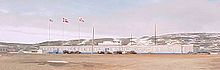
During the Cold State of war, Greenland had a strategic importance, controlling parts of the passage betwixt the Soviet Union's Chill Sea harbours and the Atlantic Ocean, as well as being a practiced base for observing any employ of intercontinental ballistic missiles, typically planned to pass over the Chill. In the beginning proposed The states purchase of Greenland, the country offered to buy it for $100,000,000 but Denmark did not hold to sell.[54] [55] In 1951, the Kauffman treaty was replaced by some other one.[ citation needed ] The Thule Air Base of operations in the northwest was made permanent. In 1953, some Inuit families were forced past Denmark to move from their homes to provide space for extension of the base. For this reason, the base has been a source of friction between the Danish government and the Greenlandic people. In the 1968 Thule Air Base B-52 crash of January 21, 1968, four hydrogen bombs contaminated the area with radioactive droppings. Although most of the contaminated ice was cleaned upwards, one of the bombs was not accounted for. A 1995 Danish parliamentary scandal, dubbed Thulegate, highlighted that nuclear weapons were routinely nowadays in Greenland's airspace in the years leading upward to the accident, and that Denmark had tacitly given the go-ahead for this activity despite its official nuclear free policy.
The United States upgraded the Ballistic Missile Early on Warning System to a phased array radar.[56] Opponents contend that the organisation presents a threat to the local population, as it would exist targeted in the consequence of nuclear state of war.
Home dominion [edit]
The American presence in Greenland brought Sears catalogs, from which Greenlanders and Danes purchased modernistic appliances and other products by mail.[57] From 1948 to 1950, the Greenland Commission studied the conditions on the island, seeking to address its isolation, diff laws, and economic stagnation. In the end, the Royal Greenland Trading Department'due south monopolies were finally removed. In 1953, Greenland was raised from the status of colony to that of an autonomous province or elective country of the Danish Realm. Greenland was besides assigned its own Danish county. Despite its small population, it was provided nominal representation in the Danish Folketing.
A plantation of exotic arctic trees was created in 1954 well-nigh Narsarsuaq.[58]

Blok P, the largest building in Greenland and formerly home to about 1% of its population, was demolished on October 19, 2012.
Denmark also began a number of reforms aimed at urbanizing the Greenlanders, principally to supersede their dependence on (and so) dwindling seal populations and provide workers for the (then) swelling cod fisheries, merely too to provide improved social services such equally wellness care, education, and transportation. These well-meaning reforms have led to a number of problems, particularly modernistic unemployment and the infamous Blok P housing project. The attempt to introduce European-style urban housing suffered from such inattention to local detail that Inuit could non fit through the doors in their winter wearable and burn down escapes were constantly blocked by fishing gear likewise bulky to fit into the cramped apartments.[59] Television broadcasts began in 1982. The collapse of the cod fisheries and mines in the tardily 1980s and early on 1990s greatly damaged the economy, which now principally depends on Danish assistance and common cold-water shrimp exports. Large sectors of the economic system remain controlled past state-endemic corporations, with Air Greenland and the Arctic Umiaq ferry heavily subsidized to provide access to remote settlements. The major drome remains the former The states air base at Kangerlussuaq well north of Nuuk, with the capital unable to accept international flights on its ain, attributable to concerns about expense and noise disturbance.
Greenland'due south minimal representation in the Folketing meant that despite lxx.3% of Greenlanders rejecting entry into the European Common Market (EEC), it was pulled in forth with Kingdom of denmark in 1973. Fears that the customs union would allow foreign firms to compete and overfish its waters were rapidly realized and the local parties began to push strongly for increased autonomy. The Folketing approved devolution in 1978 and the next year enacted home rule nether a local Landsting. On 23 Feb 1982, a blank majority (53%) of Greenland'south population voted to leave the EEC, a process which lasted until 1985. This resulted in The Greenland Treaty of 1985.[60]
Greenland Home Rule has become increasingly Greenlandized, rejecting Danish and avoiding regional dialects to standardize the land under the language and culture of the Kalaallit (West Greenland Inuit). The upper-case letter Godthåb was renamed Nuuk in 1979; a local flag was adopted in 1985; the Danish KGH became the locally administered Kalaallit Niuerfiat (at present KNI A/S) in 1986. Following a successful referendum on self-government in 2008, the local parliament'southward powers were expanded and Danish was removed as an official language in 2009.
International relations are now largely, but not entirely, besides left to the discretion of the dwelling house dominion government. As role of the treaty decision-making Greenland's exit of the EEC, Greenland was declared a "special case" with admission to the EEC market every bit a elective country of Denmark, which remains a member.[sixty] Greenland is also a member of several pocket-sized organizations[ which? ] along with Iceland, the Faroes, and the Inuit populations of Canada and Russia.[ citation needed ] Information technology was one of the founders of the ecology Chill Council in 1996. The US military bases on the isle remain a major upshot, with some politicians pushing for renegotiation of the 1951 United states–Kingdom of denmark treaty by the Dwelling Dominion regime. The 1999–2003 Committee on Cocky-Governance even proposed that Greenland should aim at Thule base's removal from American authority and operation nether the aegis of the United Nations.[61]
See besides [edit]
- Danish colonization of the Americas
- History of America
- History of Denmark
- History of Republic of iceland
- History of Kingdom of norway
- Indigenous Amerindian genetics
- Inuit
- Inuit mythology
- Norse colonization of the Americas
- Christian IV's expeditions to Greenland
Notes [edit]
- ^ "Yanks Clear Greenland of Nazis,1944/12/27 (1944)". Retrieved 2 October 2010.
- ^ "Saqqaq culture chronology". Sila, the Greenland Research Eye at the National Museum of Kingdom of denmark. Archived from the original on 19 April 2011. Retrieved 2 October 2010.
- ^ "Independence I" Archived 2009-01-thirteen at the Wayback Machine. From natmus.dk. Sila, the Greenland Research Centre at the National Museum of Denmark. Retrieved September 3, 2008.
- ^ "Independence 2" Archived 2009-01-xiii at the Wayback Machine From natmus.dk. Sila, the Greenland Research Centre at the National Museum of Denmark. Retrieved September 3, 2008.
- ^ a b J.F. Jensen (2016). "Greenlandic Dorset". In M. Friesen and O. Mason (ed.). The Oxford Handbook of the Prehistoric Arctic. Vol. i. doi:10.1093/oxfordhb/9780199766956.013.56.
- ^ "Early Dorset/Greenlandic Dorset" Archived 2011-08-12 at the Wayback Machine. From natmus.dk. Sila, the Greenland Inquiry Middle at the National Museum of Denmark. Retrieved September 3, 2008.
- ^ "Late Dorset" Archived 2009-01-13 at the Wayback Auto. From natmus.dk. Sila, the Greenland Research Center at the National Museum of Denmark. Retrieved September iii, 2008.
- ^ Grove, Jonath. "The place of Greenland in medieval Icelandic saga narrative" Archived 2012-04-11 at the Wayback Auto, in Norse Greenland: Selected Papers of the Hvalsey Conference 2008, Periodical of the Due north Atlantic Special Book 2 (2009), 30–51
- ^ "The Saga of Erik the Red". Icelandic Saga Database. Translated past Sephton, J. 1880. Retrieved 20 March 2021.
In the summer Eirik went to live in the land which he had discovered, and which he called Greenland, 'Because,' said he, 'men will desire much the more to go there if the country has a good name.'
- ^ "Timeline of the history of Norse Greenland". Archived from the original on 2017-08-04. Retrieved 2006-01-21 .
- ^ a b c The Fate of Greenland'due south Vikings
- ^ "The Wood Plantations in The Greenlandic Arboretum". 18 Oct 2013.
- ^ Northward. Lynnerup, in Fitzhugh & Ward 2000
- ^ Viking Age Greenland Ancient History Encyclopedia
- ^ a b c d Diamond 2005, p. 217,222
- ^ "Hvað er helst vitað um svartadauða á Íslandi?".
- ^ Transcription of the original letter (Latin): Diplomatarium Norvegicum XIII p.52 Date: 29 August 1408. Place: Svartland. ("[...] Bertoldus eadem gracia episcopus Gardensis [...]")
- ^ Originals in Hofbibliothek at Vienna. A Greenlander in Norway, on visit; it is also mentioned in a Norwegian diploma from 1426, Peder Grønlendiger. Transcription of the original alphabetic character: Diplomatarium Norvegicum XIII p.70 Appointment: 12 Feb 1426. Identify: Nidaros.
- ^ Transcription of the original letter: Diplomatarium Norvegicum VI p.554 Engagement: 20 Septbr. 1448. Place: Rom.
Original DN summary: "Pave Nikolaus V paalægger Biskopperne af Skaalholt og Hole at sörge for at skaffe Indbyggerne i Grönland Prester og en Biskop, hvilken sidste de ikke have havt i de 30 Aar siden Hedningernes Indfald, da de fleste Kirker bleve ödelagte og Indbyggerne bortförte som Fanger."
("Pope Nicholas 5 prescribes the Bishops of Skálholt and Hólar to ensure to provide the inhabitants of Greenland priests and a bishop, which of the latter they haven't had in the 30 years since the coming of the heathens when nearly churches were destroyed and the inhabitants taken away every bit prisoners.) - ^ Mackenzie Brown, Dale (2000-02-28). "The Fate of Greenland's Vikings". Archaeology Archive. Archaeological Institute of America. Retrieved 2018-06-13 .
I [...] [man] was establish lying face downward on the beach of a fjord in the 1540s by a party of Icelandic seafarers, who similar so many sailors earlier them had been blown off course on their passage to Iceland and wound up in Greenland. The only Norseman they would come across during their stay, he died where he had fallen, dressed in a hood, homespun woolens and seal skins. Nearby lay his pocketknife, 'bent and much worn and eaten away.'
- ^ Tristan Jones (1 April 2014). Ice!. Open Road Media. pp. 102–. ISBN978-1-4976-0357-8.
- ^ a b "Why did Greenland'due south Vikings disappear?". Science | AAAS. 2016-11-07. Retrieved 2016-12-26 .
- ^ Folger, Tim. "Why Did Greenland's Vikings Vanish?". Smithsonian . Retrieved 2017-02-26 .
- ^ Kim, Allen. "Vikings disappeared from Greenland due to over-hunting walrus, study suggests". CNN . Retrieved 2020-01-08 .
- ^ a b Seaver, Kirsten A. (2009-07-01). "Desirable teeth: the medieval trade in Chill and African ivory". Periodical of Global History. four (ii): 271–292. doi:ten.1017/S1740022809003155. S2CID 153720935.
- ^ McGovern, Thomas H. (2000). "The Demise of Norse Greenland". Fitzhugh & Ward 2000, pp. 327–339. p. 330.
- ^ Patterson, William P.; Dietrich, Kristin A.; Holmden, Chris; Andrews, John T. (2010). "Two millennia of Northward Atlantic seasonality and implications for Norse colonies". Proc. Natl. Acad. Sci. U.S.A. 107 (12): 5306–10. Bibcode:2010PNAS..107.5306P. doi:ten.1073/pnas.0902522107. PMC2851789. PMID 20212157.
- ^ Arneborg, Jette; Seaver, Kirsten A. (2000). "From Vikings to Norseman". Fitzhugh & Ward 2000, pp. 281–294. p. 290.
- ^ Fitzhugh and Ward, 2000: p. 336
- ^ Kendrick, Thomas Downing (1930). A History of the Vikings. New York: C. Scribner'south Sons. p. 366.
- ^ Grove, 2009: p. 40
- ^ Arneborg, Jette (2000). "Greenland and Europe". Fitzhugh & Ward 2000, pp. 304–317. p. 307.
- ^ Arneborg 2000, p. 315
- ^ Diamond 2005, p. 270
- ^ Seaver 1996, p. 205: a reference to sailors in Bergen in 1484 who had visited Greenland (Seaver speculates that they may have been English language); p.229ff: archaeological evidence of contact with Europe towards the end of the 15th century
- ^ Karlsson, Gunnar (2000). The History of Iceland. University of Minnesota Press. p. 103. ISBN978-0-8166-3589-four.
- ^ Arneborg, J.; Heinemeier, J.; Lynnerup, N.; Nielsen, H.L.; Rud, Northward.; Sveinbjornsdottir, A.E. (2002). "C-14 dating and the disappearance of Norsemen from Greenland" (PDF). Europhysics News. 33 (3): 77–80. Bibcode:2002ENews..33...77A. doi:10.1051/epn:2002301.
- ^ Appelt, Martin; Damkjar, Eric; Friesen, Max (2016). Friesen, Max; Mason, Owen (eds.). Tardily Dorset. doi:ten.1093/oxfordhb/9780199766956.013.36. ISBN978-0-19-976695-6.
- ^ a b D'Andrea, William J.; Huang, Yongsong; Fritz, Sherilyn C.; Anderson, N. John (2011). "Sharp Holocene climatic change as an important gene for human migration in West Greenland". Proc. Natl. Acad. Sci. UsA. 108 (24): 9765–ix. Bibcode:2011PNAS..108.9765D. doi:ten.1073/pnas.1101708108. JSTOR 25831309. PMC3116382. PMID 21628586.
- ^ Sørensen, Mikkel; Gulløv, Hans Christian (2012). "The Prehistory of Inuit in Northeast Greenland". Arctic Anthropology. 49 (ane): 88–104. doi:10.1353/arc.2012.0016. JSTOR 24475839. S2CID 162882708.
- ^ Helgason, Agnar; Pálsson, Gísli; Pedersen, Henning Sloth; Angulalik, Emily; Gunnarsdóttir, Ellen Dröfn; Yngvadóttir, Bryndís; Stefánsson, Kári (2006-05-01). "mtDNA variation in Inuit populations of Greenland and Canada: Migration history and population structure". American Journal of Concrete Anthropology. 130 (one): 123–134. doi:x.1002/ajpa.20313. PMID 16353217.
- ^ a b Outram, Alan Thousand. (1999). "A Comparison of Paleo-Eskimo and Medieval Norse Bone Fat Exploitation in Western Greenland" (PDF). Arctic Anthropology. 36 (one/ii): 103–117. JSTOR 40316508.

- ^ Lynnerup, Niels (2015). "The Thule Inuit Mummies From Greenland". The Anatomical Record. 298 (6): 1001–1006. doi:10.1002/ar.23131. PMID 25998634. S2CID 7773726.
- ^ a b c Keller, Christian. "The Eastern Settlement Reconsidered. Some analyses of Norse Medieval Greenland". Accessed 10 May 2012.
- ^ Inter alia, cf. Permanent Court of International Justice. "Legal Status of Eastern Greenland: Judgment Archived 2011-05-xi at the Wayback Machine". 5 Apr 1933. Accessed 10 May 2012.
- ^ a b Del, Anden. "Grønland som del af den bibelske fortælling – en 1700-tals studie Archived 2012-07-fifteen at the Wayback Machine" ["Greenland equally Office of the Biblical Narrative – a Study of the 18th-Century"]. (in Danish)
- ^ a b Cranz, David & al. The History of Greenland: including an business relationship of the mission carried on past the United Brethren in that country. Longman, 1820.
- ^ Marquardt, Ole. "Modify and Continuity in Denmark'southward Greenland Policy" in The Oldenburg Monarchy: An Underestimated Empire?. Verlag Ludwig (Kiel), 2006.
- ^ Mirsky, Jeannette. To the Chill!: The Story of Northern Exploration from Primeval Times. Univ. of Chicago Printing, 1998.
- ^ Nationalmuseet of Denmark. "Thule Archived 2007-03-13 at the Wayback Automobile".
- ^ Farley Mowat, The Polar Passion: The Quest for the N Pole. McClelland and Stewart, 1967, pp. 199-222
- ^ Eve Garnett, To Greenland's icy mountains; the story of Hans Egede, explorer, coloniser, missionary (London: Heinemann. 1968)
- ^ a b c "The Sledge Patrol". The Chill Journal. Archived from the original on 2017-03-08. Retrieved 2017-03-08 .
- ^ Time Mag Monday, Jan 27, 1947 "Deepfreeze Defence force":
- ^ National Review May 7, 2001 "Let'southward Buy Greenland! – A complete missile-defense programme" By John J. Miller (National Review's National Political Reporter:
- ^ Taagholt, Jørgen & Jens Claus Hansen (Trans. Daniel Lufkin) (2001). "Greenland: Security Perspectives" (PDF). Fairbanks, Alaska: Arctic Research Consortium of the The states. pp. 35–43. Archived (PDF) from the original on 2010-12-23.
- ^ Lockhart, Katie (2019-12-27). "How This Abased Mining Boondocks in Greenland Helped Win Earth War Ii". Smithsonian . Retrieved 2019-12-28 .
- ^ "Skovplantninger i Det Grønlandske Arboret". 2013-10-ten.
- ^ Bode, Mike & al. "Nuuk". 2003. Accessed xv May 2012.
- ^ a b Government of Greenland. "The Greenland Treaty of 1985". Accessed 2 Oct 2018.
- ^ "International relations". Archived from the original on 2007-02-21. Retrieved 2007-04-06 .
Bibliography [edit]
- Diamond, Jared (2005). Collapse: How Societies Cull to Neglect or Succeed. Viking. ISBN978-0-fourteen-303655-5.
- Seaver, Kristen A. (1996). The Frozen Echo. Stanford University Press. ISBN978-0-8047-3161-4.
- Grove, Jonathan (2009). "The place of Greenland in medieval Icelandic saga narrative". Journal of the N Atlantic. Special Volume two: Norse Greenland: Selected Papers of the Hvalsey Conference 2008: 30–51. doi:x.3721/037.002.s206. S2CID 163032041. Archived from the original on 2012-04-11.
- Kendrick, T.D. (2012) [1930]. A History of the Vikings. Courier. ISBN978-0-486-12342-4.
- Hreinsson, Viðar, ed. (1997). The Consummate Sagas of Icelanders, Including 49 Tales. Reykjavík: Leifur Eiríksson. ISBN978-9979929307.
- U.Southward. National Museum of Natural History (2000). Fitzhugh, William W.; Ward, Elisabeth I. (eds.). Vikings: The Northward Atlantic Saga . Smithsonian Establishment Press. ISBN978-1560989707.
- Gulløv, Hans Christian, ed. (2005). Grønlands forhistorie. Gyldendal: National Museum of Kingdom of denmark. ISBN978-87-02-01724-3.
- Greenland during the Cold State of war. Danish and American security policy 1945–1968. Copenhagen: Danish Institute of International Diplomacy (DUPI). 1997-01-17. ISBN978-87-601-6922-9. LCCN 97161960.
External links [edit]
- The cultural history of Greenland – Data well-nigh the diverse cultures, from the Greenland Inquiry Center and the National Museum of Denmark
- What Happened to the Greenland Norse? – With video sequences, from the US National Museum of Natural History
- The Fate of Greenland'south Vikings – Another account, from the Archaeological Institute of America
- Broken Arrow – The B-52 Blow – Business relationship of the 1968 cleanup process
- Star Wars and Thule – Bringing the Common cold State of war Dorsum to Greenland – 2001 Greenpeace written report.
- Timeline of the history of Norse Greenland
- History of Medieval Greenland and associated places, like Iceland and Vinland.
- Magnússon, Finnur; Rafn, Carl Christian (1838). Grönlands historiske mindesmærker (in Danish). Trykt i det Brünnichske bogtr.
- Introduction of Greenland - Lessons from the far n
Source: https://en.wikipedia.org/wiki/History_of_Greenland
0 Response to "Review Danish War Axe by Arms & Armor -"
Post a Comment