Best Time to Expose Baby to Sun for Vitamin D
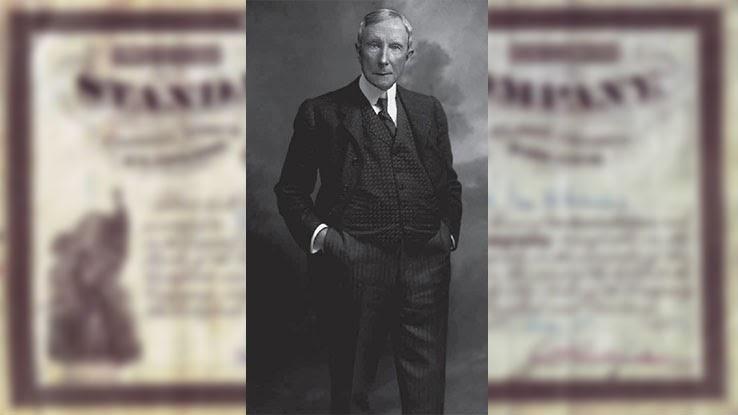
John D. Rockefeller'southward name is synonymous with wealth, and he'southward one of the about controversial business tycoons in America'southward history. From his monopolistic Standard Oil to various ventures in banking and aircraft, Rockefeller's empire connected to thrive, even subsequently infamous antitrust suits.
Regardless of opinions virtually his ethics, John D. Rockefeller was able to overcome times of war and turmoil to turn a considerable turn a profit. Determining how he became then accomplished involves taking a more in-depth look into the life of America's wealthiest human being.
Son of a Con Artist
John D. Rockefeller was the son of William Avery "Devil Bill" Rockefeller, who was a businessman and lumberman earlier becoming a well-known con artist. He claimed to be a "botanic physician" who sold various elixirs to unsuspecting customers. Devil Bill was as well involved with swindling customers using his other business of land speculation.

Pecker found desperate farmers who could barely bring in sufficient income. He gave them loans with a 12% interest rate. The high-take a chance borrowers often savage to foreclosure, assuasive Rockefeller to dive in and have their farms.
Devil Bill lived the life of a vagabond and was abroad from dwelling house for extended periods. Nib's mistress was likewise the family housekeeper; he fathered two children with her. A patient homemaker, Devil Bill's wife (John's mother) put up with his double life, including bigamy with his mistress.

John and his brothers were likewise victims of their father's grifting. Bill fifty-fifty said, "I cheat my boys every take chances I get. I want to make them precipitous." The just business organisation trait John earned from his begetter was to enter a deal that was a certain affair.
Mentored by His Mother
Because Pecker was rarely dwelling house, John helped his mother, Eliza, every bit much as he could. He completed various household chores and earned money raising turkeys and selling potatoes and processed. Eliza, a devout Baptist, taught John to exist prudent with his income as "willful waste material makes woeful want."

Eliza was a far more significant influence on John than his father was. She inspired him to share his wealth, and he afterward became an ardent philanthropist. "From the beginning, I was trained to work, to save and to give," he claimed. His respect for money led to his training every bit a bookkeeper.
Beginnings in Bookkeeping
Earlier becoming an oil tycoon, John D. Rockefeller attended the get-go public high school in Cleveland, Ohio. Following graduation, his interest in money led to the completion of a 10-week business course studying bookkeeping. John was an academic and took his education seriously.

He earned his kickoff financial role for a produce company when he was only 16 years former. He had a penchant for transportation costs and business operations. John began earning $sixteen per calendar month as an apprentice, and somewhen, he received $58 each month based on his successful collections capabilities.
A Musical Background
John possessed an innate concern understanding that his mother helped nurture. He was honest notwithstanding business firm. A skilled communicator, Rockefeller became known for his ability to negotiate transportation rates with culvert owners, ship captains and freight agents based on marketplace conditions.

If he hadn't been such an expert at debt collection and negotiation, leading to significant earnings, Rockefeller might have wound upwards in a completely dissimilar identify. He had a passion and fondness for music and in one case considered it for a career.
Rockefeller's Personal Loan Shark
Following his time equally a bookkeeper, John D. Rockefeller decided to improve his odds of success. Taking what he had learned from his time in the produce-commission business, he joined forces with his partner, Maurice B. Clark. Clark contributed $2,000 of their full $4,000 upper-case letter, but John only had $800 saved.

Rockefeller borrowed the residuum from his father; Devil Bill gave John a loan of $one,000. Even though it was for his son, he still charged an interest rate. Lower than his standard 12%, Bill offered the loan at 10% interest.
Abolitionist Draft Dodger
The Civil War caused massive nutrient shortages due to the need for military supplies. Rockefeller's business boomed as the war dragged on. John'south brother Frank fought for the North, only John was able to avoid service. He did so by donating to the Spousal relationship army. It was a common do for wealthy people to stay off the battlefield.

John was a Republican and robust abolitionist who voted for Abraham Lincoln. He considered it his duty equally a wealthy American patriot to donate to the Northern cause, something that was instilled upon him by his mother.
The Civil War and Oil
The federal authorities began subsidizing oil, which drove the price from $0.35 a barrel to $thirteen.75 a butt in 1862. Even with high transportation costs and additional levies on refined oil, Rockefeller and his partner decided to enter this new blast. They switched from produce to oil in 1863 with the purchase of a refinery near Cleveland.

Most companies kept 60% of the oil production as kerosene and dumped the rest. A thrifty Rockefeller sold the remaining forty% for other uses. In 1865, he bought out his partners, which he said determined his career.
Oil Profits Grow
Unlike today, the oil industry was relatively modest. Consumers used whale oil to calorie-free candles and estrus homes, although the product was far too expensive for centre class consumers. Throughout the 1870s, kerosene became far more attainable and easier to ship due to reduced freight rates.

Rockefeller's thrifty nature and use of the entirety of his oil led to cheaper availability of kerosene and other oil byproducts. Rockefeller became the most assisting oil refiner and the largest shipper in Ohio. He made his product attainable to consumers, no affair their socioeconomic class.
The Cleveland Massacre
John D. Rockefeller'due south peachy business organisation nature led to Standard Oil's exponential growth. Every bit a practice, John pinpointed his least-efficient competitors and targeted them for purchase. Based on his low costs and ability to raise uppercase, he was able to undercut his competitors and forcefulness them to sell.

He went through a cursory period known equally "The Cleveland Massacre" in which he fabricated hugger-mugger deals leading to Standard Oil'southward attainment of 22 out of 26 Ohio competitors within four months. The remaining competitors realized that resistance was futile and made deals with him for the purchase of their companies.
Vertical Integration Creation
Some people picture business organization tycoons every bit ruthless businessmen who desire to destroy their contest. John D. Rockefeller's view was far more messianic. He thought of himself more equally a savior to the industry rather than its sole leader. His ownership of pipelines and other delivery methods kept prices depression and increased competition.

As Rockefeller's successor put it, "That orderly, economic, efficient flow is what we now, many years later, call 'vertical integration.' I do not know whether Mr. Rockefeller ever used the word 'integration.' I only know he conceived the idea."
Other Than Oil…
By the late 1870s, Standard Oil was responsible for 90% of the United States' refined oil. The visitor was growing both vertically and horizontally. Its products had constitute their mode into most every American household. Standard Oil's increased market share and profits immune the company to expand and begin marketing other products.

Considering Standard Oil was using nearly 100% of the oil it produced, the company developed over 300 other oil-based products. It was responsible for introducing everything from chewing gum and petroleum jelly to pigment and tar. Rockefeller had go a millionaire at this point, worth $26 one thousand thousand by today'southward exchange rates.
Standard Oil vs. Pennsylvania Railroad
Because Standard Oil was investing in oil pipelines as a less-expensive transportation method, railroad companies began to observe — especially Standard Oil's principal hauler, Pennsylvania Railroad. The railroad formed a subsidiary to enter the oil-refining industry, leading to a considerable business battle and cost state of war.

Standard held back its shipments and reduced prices with the help of other railroads. After a hard-fought battle, Pennsylvania Railroad had to concede. The company sold its oil interests to Standard Oil, increasing Standard's stranglehold on the industry. The fight led to the first of many legal battles in Standard'southward existence.
Developing Anxiety
In the wake of Standard Oil's battle with Pennsylvania Railroad, the Commonwealth of Pennsylvania took activity and indicted John D. Rockefeller for monopolizing the oil industry. Lawsuits from other states trickled in, causing Standard Oil to receive a large amount of media attention, and subsequent criticism, for its business practices.

Standard's legal conflicts lasted through the stop of the 1880s. Under considerable stress, Rockefeller could not sleep. The abiding attacks from the printing acquired him to say, "All the fortune that I have made has not served to recoup me for the anxiety of that menses."
Standard Oil Trust
Standard Oil already gained a 90% market share of the American oil industry, fifty-fifty though hundreds of competitors existed. The criticisms of Standard Oil underselling, pricing and offering transportation rebates had allowed the company to enter a majority of American households. New York World chosen the company "the most barbarous, impudent, pitiless and grasping monopoly that always fastened upon a land."

Standard achieved this by creating different corporations; information technology was difficult for companies to operate in multiple states at the time. Standard Oil's lawyers centralized the company'due south 41 holdings by creating the Standard Oil Trust.
The Largest Company in the World
Criticized by competitors and consumers, the Standard Oil Trust caused the company to go the wealthiest and largest business organisation in the world. Standard Oil was seemingly unstoppable and made large profits year over year. Many other companies saw Standard's invincibility and formed trusts of their own.

At its peak, Standard Oil boasted over 100,000 employees and owned 20,000 wells and 5,000 tank cars with 4,000 miles of pipeline. Increased public scrutiny caused Rockefeller to realize he would never ain 100% of the country's oil. Standard'south market share began to driblet.
Creating the Oil Futures Marketplace
During Standard Oil's market share drib, John D. Rockefeller's innovative business listen continued to grow. He changed the way the company charged for oil storage based on marketplace conditions. Rockefeller traded certificates to speculators against any oil that was stored in his pipelines, leading to the first oil futures market.

The new and innovative marketplace established all oil prices for the foreseeable future. In 1882, the National Petroleum Exchange opened to facilitate this trading. The oil manufacture was now an international phenomenon with oil fields discovered in Russia and Asia.
Other Oil-based Products
Kerosene was finally on its mode out as a source of illumination due to the invention of the calorie-free seedling. Standard Oil began to develop the natural gas market place in the United states. Cheaper oil fields in Russia, the development of the world'southward first oil tanker and wealthy financiers, including the Rothschilds, forced Rockefeller to suit.

Primarily considered a waste product, automobile gasoline wasn't a common product for many oil companies at the time. Equally it had always washed, Standard Oil institute a niche market and proved in one case again that it wasn't going to bow to market pressures.
Relocation to the Big Apple tree
In the early 1880s, Standard Oil'due south headquarters relocated to New York Urban center, and Rockefeller became a key business icon. He purchased a firm near the mansion of William Henry Vanderbilt on 54th Street. Even with his expansive wealth and highly recognizable face, John D. Rockefeller took the elevated train to his office each day.

He was unable to keep himself from the masses. On a regular basis, Rockefeller received threats to his life. Countless residents knew how much money he had and continually asked for charity, still he kept utilizing public transportation.
The Start of Standard Oil'due south Cease
Businesses were getting out of hand by the late 1890s. Unions formed to protect workers, simply the unions themselves weren't immune to corruption. Congress passed the Sherman Antitrust Act of 1890 to regulate the unions. States used the constabulary to fight against Standard Oil's trust.

Ohio took the start step by using its antitrust laws to forcefulness Standard Oil of Ohio from the rest of the corporation. From at that place, other states followed, and the official breakdown of Standard Oil'southward trust had begun. Rockefeller did everything he could to keep his company relevant.
Rockefeller vs. Carnegie
Because of the breakup of Standard Oil'south trust, the conglomerate entered the iron ore industry, including its means of transportation. The new venture caused a clash with American steel tycoon Andrew Carnegie, who was no stranger to competition. Paper cartoonists aimed their criticisms at the two millionaires during that menstruum.

Not ready for some other round of business and legal battles, Rockefeller began to consider his retirement. J.P. Morgan swooped in and purchased both Carnegie's steel and Rockefeller'south iron interests. Rockefeller earned a place on the board of directors and $58 1000000 in full investments.
Tarnishing Rockefeller'due south Legacy
In 1904, Ida Tarbell wrote a work describing the diverse shady dealings and practices of John D. Rockefeller and Standard Oil. She wrote nigh the cost wars, marketing techniques and legal battles in the publication "The History of the Standard Oil Company." Information technology all but tarnished the legacy of America'due south richest man.

The backlash against Rockefeller was staggering, and even Tarbell herself was surprised by the outcome. "I never had an animus against their size and wealth, never objected to their corporate form," she said, "but they had never played off-white, and that ruined their greatness for me."
Inverse Opinions
The backfire from Ida Tarbell's "The History of the Standard Oil Company" had a personal effect on Rockefeller. He never publicly shamed "that misguided woman" who wrote the publication. Still, Rockefeller's private business relationship of the author, whose male parent he had driven out of the oil business, was quite harsh.

John D. Rockefeller was notorious for fugitive the printing. He took this opportunity to conduct a press tour to improve his public perception. The views that his company followed established laws and ethical business practices fell upon deaf ears.
The U.Due south. vs. Standard Oil
John D. Rockefeller's tenacity connected into the 20th century, and John and his son furthered their fight to consolidate their oil business organisation. The state of New Bailiwick of jersey'due south laws changed in 1909 and immune for them to incorporate their holdings under i company, and Rockefeller was temporarily back in business.

The Supreme Court of the U.s. had something else in listen. In 1911, the high courtroom establish that Standard Oil had violated the Sherman Antitrust Act. The court forced the illegal monopoly to break up. Standard Oil was no longer the largest oil company in the globe.
Breaking Up Standard Oil
Considering the Supreme Court had ruled that Standard Oil was an illegal monopoly, the Sherman Antitrust Deed forced it to break upward its assets. Standard Oil was to become 34 new companies. Many of those companies are even so in being today and are quite recognizable.

These include ConocoPhillips, Amoco (which is office of British Petroleum), Chevron, ExxonMobil and Pennzoil. Rockefeller held on to significant shares in each of the companies. Although he was no longer in control of the oil industry, he profited tremendously.
The Rockefeller Dynasty
John D. Rockefeller was married to Laura Celestia Spelman in 1864. From 1866 through 1874, the couple had four daughters, Elizabeth, Alice, Alta and Edith, and ane son, John Jr. The kids besides had children, many of whom went on to pb very successful lives in public service and business.

John Jr.'s youngest son, David, served equally CEO of Chase Manhattan Bank for over twenty years. His second son, Nelson, was elected governor of New York before becoming the 41st Vice President of the Usa. Another son, Winthrop, served as the Governor of Arkansas.
Family Philanthropy
John D. Rockefeller was the original creator of the conditional grant. The beneficiary was required to "root the institution in the affections of as many people as possible who, equally contributors, become personally concerned, and thereafter may be counted on to requite the institution their watchful involvement and cooperation."

John's wife, Laura, was also a supporter of civil rights and equality. They offered a massive donation to the Atlanta Baptist Female Seminary in Atlanta. The higher for African-American women was afterward named Spelman Higher in honor of his wife's family proper noun.
Religious Views
During John D. Rockefeller's boyish years, the Second Great Awakening drew people to various Protestant churches. He attended the Erie Street Baptist Church with his mother, Eliza. The revival flow promoted values such every bit hard piece of work and proficient deeds, something Rockefeller attributed his philanthropic work to in his later years.

His mother encouraged him to put a few cents into the offer basket each Sunday. He ultimately related charity to the church. Afterward, he would remember, "It was at this moment that the fiscal plan of my life was formed."
Health Issues and Death
John D. Rockefeller suffered from moderate low. During the stressful period of his life, while he was dealing with negative press and lawsuits, he developed alopecia. The status led to considerable hair loss. To embrace it upwards, he began to wear toupeés.

Rockefeller was a workhorse, and his health improved as his work decreased. Despite his appetite to live until he was 100 years old, John D. Rockefeller passed away due to complications related to arteriosclerosis simply shy of his 98th birthday in 1937. He died in Florida, and his body rests in Lake View Cemetery in Cleveland.
The Rockefeller Legacy
John D. Rockefeller is known equally the richest man in United states of america history. A real instance of the American Dream, the name Rockefeller will forever be associated with wealth and success. Regardless of his controversies, no one can dispute his ability to make a business thrive, fifty-fifty during wartime and economic downturns.

By the get-go of World War I, Rockefeller was worth around $900 1000000. Co-ordinate to his obituary, the concern tycoon amassed well-nigh $1.5 billion from Standard Oil and other businesses in banking, shipping, mining, railroads and diverse other enterprises.
Best Time to Expose Baby to Sun for Vitamin D
Source: https://www.life123.com/lifestyle/john-rockefeller-wealthiest-american?utm_content=params%3Ao%3D740009%26ad%3DdirN%26qo%3DserpIndex
0 Response to "Best Time to Expose Baby to Sun for Vitamin D"
Post a Comment